2021 Visual Literacy in the Virtual Realm

Headshot of Jung Lee, Professor at Stockton University.
2021 Visual Literacy in the Virtual Realm

Editor’s Note: Selected Readings 2021

Selected Readings Editorial Philosophy IVLA is an eclectic organization of professionals working toward a fuller understanding of how we derive meaning from what we see and how we interact with our visual environment. IVLA members represent a wide range of disciplines including the arts, sciences, education, museum, library, communication, business, videography, photography, instructional technology, health, and computer applications. What makes the Selected Readings special, like the members of IVLA who have contributed to it, is that it represents this broad range of interests and reflects some of the most diverse thinking in the field of visual communication. Each year, members come together at a conference held in conjunction with a college, university or organization to present their ongoing work and to share perspectives in a multidisciplinary forum. Characterized by many different voices, and cross-fertilization of ideas, interests and values, discussion is a lively mix of scholarship, creativity, and applications. Since the founding of the organization in 1968, this dynamic interaction between practitioners and theorists has been IVLA’s greatest strength. This peer reviewed collection of papers is selected from the presentations at the annual IVLA Conference. It is meant to reflect the spirit of the ongoing conversation among its diverse members and to promote new perspectives in its readers. Included in the Selected Readings are creative ideas in the making, works in progress that invite further thought and the results of long-term scholarly research. We are proud to present these multi-faceted works for your consideration. Jung Lee Editor, Visual Literacy in the Virtual Realm: The Book of Selected Readings 2021 Read the full book here.
Read More »
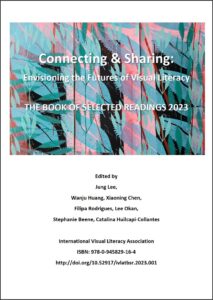
The Book of Selected Readings 2021 Cover
2021 Visual Literacy in the Virtual Realm

Welcome to the Book of Selected Readings 2021

Visual Literacy in the Virtual Realm: The Book of Selected Readings 2021 (eds. J. Lee, S. Christensen, S.Beene, X. Chen, and W. Huang) Table of Contents Cover Art i Selected Readings Editorial Philosophy iii Editorial Team iv Juried Papers (listed in alphabetical order by first author) The Color Pile: Equitable Self-Expression Through Color and Abstraction 1 Kathryn de Laszlo The “Shaken Photos” Project as a Stimulus for Developing Creative Thinking with Preschoolers 13 Katerina Dermata Supporting Visual Literacy in Nursing 20 Jacqueline Fleming Library Exhibitions and Visual Literacy 30 Patti Gibbons Carol Ng-He A Visual Design Framework and Assessment to Inform Instruction 39 Sarah Huber Sivanand Puliyadi Ravi Visual Encounters with the Past: Teaching Visual Literacy to Enhance Historical and Cultural Understanding 53 Peggy Keeran Katherine Crowe Jennifer Bowers Visuals that Portray a Wind Farm 68 Mary Le Rouge Visual Literacy and Virtual Rephotography. 81 Gary McLeod Virtual Construction Kits 94 Nikolay Selivanov

Read More »
2021 Visual Literacy in the Virtual Realm

The Color Pile: Equitable Self-Expression Through Color and Abstraction

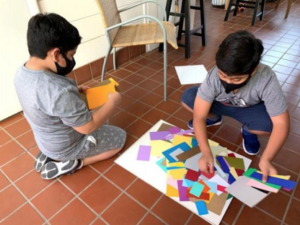
The Color Pile: Equitable Self-Expression Through Color and Abstraction Kathryn de Laszlo Visual literacy and visual resources educator, USA Abstract The Color Pile is a visual tool transported from the author’s art-student context, and builds on the teaching model of Connie Smith Siegel and the Color Contrast work of Johannes Itten. As re-positioned, it offers a novel path to eliciting student narratives and point of view in language-dependent learning settings. Can this playful exercise support the clear articulation of complex ideas and help generate descriptive language? The Color Pile process moves from prompt to reflection to abstract visual composition, and resolves in a verbal, written or drawn reflection. Color and abstraction may help students gain access to their full capacities for complex thought and self-expression. Could this approach provide differently equitable support for student-produced narratives and descriptive language than is afforded by viewing representational imagery? Direct observations of middle school students using the Color Pile suggest the method could be meaningful to a diverse audience of teachers and learners. Its usefulness in a broad spectrum of language-oriented learning settings is considered. Keywords: Multimodal literacy, personal narrative, culturally responsive teaching, lived experience, expressive color Read the chapter here

Read More »
The Book of Selected Readings 2021 Cover
2021 Visual Literacy in the Virtual Realm

The “Shaken Photos” Project as a Stimulus for Developing Creative Thinking with Preschoolers

The “Shaken Photos” Project as a Stimulus for Developing Creative Thinking with Preschoolers Katerina Dermata Panteion University of Social and Political Sciences, Greece Abstract Using a digital camera to achieve a successful result requires from the user, first and foremost, to be familiar with the proper use of the medium and to have obtained basic knowledge of the principles of the art of photography. What is the result in those cases where the photographer either does not know the basic principles of photography or cannot apply them effectively in practice? Is the product considered a “failure” thus leaving photos with no clear and recognizable objects? This paper focuses on designing and implementing an applied educational intervention, themed on ”shaken” photos taken by preschoolers and using this material to create digital narratives. This case study examines “shaken” photos as an opportunity to develop imagination and creativity through photography. Keywords: creative thinking, visual literacy, photos, preschool education, digital narrations Real the chapter here

Read More »
The Book of Selected Readings 2021 Cover
2021 Visual Literacy in the Virtual Realm

Supporting Visual Literacy in Nursing

Supporting Visual Literacy in Nursing Jacqueline Fleming Indiana University, USA Amy Minix Indiana University, USA Abstract COVID-19 impacted in person learning, particularly for the health sciences. Nursing students learn valuable clinical skills in simulation labs on campus. When one university campus stopped in person instruction during the 2020 spring semester, two librarians worked together to identify resources to support a nursing course that quickly switched to remote learning. These resources ranged from library licensed content to free virtual reality simulations. In order to identify materials, the librarians first defined visual literacy within nursing, as well as met with various constituents to understand curriculum goals and needs. Making connections with both the faculty and the curriculum was the impetus for examining similarities between the Association of College and Research Libraries Visual Literacy Competency Standards and the American Association of Colleges of Nursing Clinical Resources Essentials for Baccalaureate Nursing Education. Both librarians are eager to continue working on strategically and systematically incorporating visual literacy library instruction into the nursing curriculum. Keywords: Visual Literacy, Nursing Education, Health Sciences, Virtual Reality Read the full chapter here

Read More »
The Book of Selected Readings 2021 Cover
2021 Visual Literacy in the Virtual Realm

Library Exhibitions and Visual Literacy

Library Exhibitions and Visual Literacy  Patti Gibbons University of Chicago, USA Carol Ng-He University of Chicago, USA Abstract Library exhibitions showcase collections and can be laboratories where users apply key visual literacy skills, such as making close observations, practicing interpretation, and challenging assumptions. Library exhibitions facilitate self-directed inquiry and have a wide pedagogical range. At academic libraries, faculty include exhibition curation and viewing in their curriculum to promote scholarship and activism. Public libraries use exhibitions to cultivate civic interest and encourage intergenerational and multi-cultural learning. Across settings, exhibition experiences support visual learning, prompt critical thinking, and mobilize change. Through examining contemporary library engagement models such as the American College and Research Library’s Visual Literacy Competency Standards for Higher Education, this paper provides examples of exhibits that illustrate ACRL’s visual literacy benchmarks. Additionally, the paper provides a brief overview of recommendations for partnering with libraries to expand opportunities for visual learning. Keywords: Association of College and Research Libraries, curation, engagement practices, library exhibitions, visual literacy Read the full chapter here

Read More »
The Book of Selected Readings 2021 Cover
2021 Visual Literacy in the Virtual Realm

A Visual Design Framework and Assessment to Inform Instruction

A Visual Design Framework and Assessment to Inform Instruction Sarah Huber Purdue University, USA Sivanand Puliyadi Ravi Purdue University, USA Abstract As evidence of meeting program criteria required by the Accreditation Board for Engineering and Technology (ABET), engineering technology (ET) students are expected to both read and create graphical communications. Academic librarians’ visual literacy (VL) instruction can support ET students’ ability to communicate through graphics. Under comprehensive VL instruction, teaching visual design principles is an area of VL that supports graphical communication. An adaptive comparative judgment (ACJ) assessment was given to 115 ET students to inform visual design instruction and future research. A visual design framework supplemented the assessment to familiarize students with visual design principles. ACJ offers an alternative assessment model because instead of grading against a rubric of learning outcomes, it uses context to judge the quality of a work. The assessment results outline specific areas to focus visual design instruction for students to effectively navigate and create graphical communications.  Keywords: Visual literacy, assessment, visual design, adaptive comparative judgment, visual literacy instruction Read the full chapter here

Read More »
The Book of Selected Readings 2021 Cover
2021 Visual Literacy in the Virtual Realm

Visual Encounters with the Past: Teaching Visual Literacy to Enhance Historical and Cultural Understanding

Visual Encounters with the Past: Teaching Visual Literacy to Enhance Historical and Cultural Understanding Peggy Keeran University of Denver, USA Katherine Crowe University of Denver, USA Jennifer Bowers University of Denver, USA Abstract At the University of Denver, the reference librarians and special collections curator have developed strategies to incorporate visual literacy into instructional sessions across multiple disciplines. In this chapter, we will discuss our collaborations with faculty in anthropology and in history to help students interpret tangible and digital archival visual information that will inform their understanding of historical contexts and meet learning outcomes in two classes: “Native American Resistance in the Digital Age” and “World War I.” Whenever we partner with faculty to include visual literacy in non-arts courses, we start with course outcomes and work with the faculty to determine how the incorporation of visual literacy can help reach those goals. Our process is iterative, practice based, flexible, and ever evolving. This chapter will provide practical strategies that educators can use to implement this type of collaboration at their own institutions. Keywords: critical visual literacy, information literacy, librarian/curator/faculty collaborations, primary source research Read the full chapter here

Read More »
The Book of Selected Readings 2021 Cover
2021 Visual Literacy in the Virtual Realm

Visuals that Portray a Wind Farm

Visuals that Portray a Wind Farm Mary Le Rouge Kent State University, USA Abstract John Debes, the founder of the IVLA, argues that our first language is body language – visual and tactile information together helping us make sense of the world (Debes, 1972). During research of the public response to what could be the first freshwater offshore wind farm in North America, on Lake Erie, participants have a distinctly embodied understanding of environmental information. Their oral stories, drawings, and written responses reflect use of visual literacy that personifies wind turbines, the lake, fish and birds, and Earth’s processes as human in nature. In return, participants’ perception of the wind farm’s features, size, and distance is skewed toward an immediate, physical presence. Between anthropomorphism and embodiment, what the general population sees as important in a large-scale sustainable energy project is very different from what is shown in technical documentation from scientists, engineers, and policymakers, complicating public decision making. Keywords: technical communication, perception, embodiment, metaphor, environmental communication Read the full chapter here

Read More »
The Book of Selected Readings 2021 Cover
2021 Visual Literacy in the Virtual Realm

Visual Literacy and Virtual Rephotography

Visual Literacy and Virtual Rephotography Gary McLeod University of Tsukuba, Japan Abstract Rephotography is a varied set of practices that begin with taking one or more pictures of the same subject. Valued for generating conversations in-situ about a place over time, recent large-scale migration to online learning draws attention to rephotography’s virtual modes. From examples that use online location software (e.g., Google Street View) to those in video game worlds, virtual rephotography might present convenient windows to unreachable destinations. However, rephotographing without having visited actual vantage points needs to take into account complexity and disjointedness introduced by such tools. Drawing from the author’s current practice-led research into photomedia, visual literacy and temporality in Northeastern Japan, emergent particularities are discussed for developing visual literacy through a necessary application of Google Street View. Keywords: Virtual rephotography, visual literacy, photomedia, temporality, Google Street View Read the full chapter here

Read More »