2022 Seeing across Disciplines

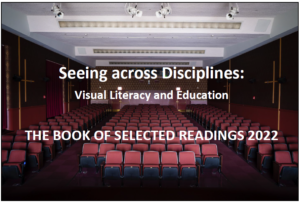
The Book of Selected Reading 2022 Cover
2022 Seeing across Disciplines

Editor’s Note: Selected Readings 2022

The Book of Selected Readings Editorial Philosophy IVLA is an eclectic organization of professionals working toward a fuller understanding of how we derive meaning from what we see and how we interact with our visual environment. IVLA members represent a wide range of disciplines including the arts, sciences, education, museum, library, communication, business, videography, photography, instructional technology, health, and computer applications. Each year, members come together at a conference held in conjunction with a university, museum or organization to present their ongoing work and to share perspectives in a multidisciplinary forum. Characterized by many different voices, and cross-fertilization of ideas, interests and values, discussion is a lively mix of scholarship, creativity, and applications. Since the founding of the organization in 1968, this dynamic interaction between practitioners and theorists has been IVLA’s greatest strength. The Book of Selected Readings (BSR) is a peer reviewed collection of papers, selected from the presentations at the annual IVLA Conference. It is meant to reflect the spirit of the ongoing conversation among its diverse members and to promote new perspectives in its readers. Included in the BSR are creative ideas in the making, works in progress that invite further thought and the results of long-term scholarly research. What makes the BSR special, like the members of IVLA who have contributed to it, is that it represents this broad range of interests and reflects some of the most diverse thinking in the field of visual communication. In addition, the BSR truly presents the international perspectives. For the 2022 BSR, 12 published articles came from 7 difference countries, such as Netherland, Syria, Russia, Brazil, Egypt, and Canada as well as USA. We are proud to present these multi-faceted works for your consideration. International Visual Literacy Association Publications Committee First stated in 1998 Jung Lee, Editor-in-chief 2022 Read the whole book here.   

Read More »
2022 Seeing across Disciplines

Welcome to the Book of Selected Readings 2022

Table of Contents    Cover Art   Selected Readings Editorial Philosophy   Juri procedure and the Editors’ Choice Award   BSR Editorial Team   International online juried art exhibition   Juried Papers   EDITORS’ CHOICE AWARD WINNER Designing an Information Comic Maaike Wessels-Compagnie, Netherland   (Alphabetical order by first author’s last name)   The Allegory and Metaphor in Visual Arts Esraa Abdelfatah, Egypt   Visual Edutainment to Engage Online Learners Amy S. Ackerman, USA Mary Jane Murphy-Bowne, USA   Seeing Across Disciplines: An Experiment in Visual Literacy across Higher Education Heidi Appel, USA Michael Deetsch, USA   Learner-Generated Visualizations and Their Evaluation: A Generative Learning Perspective Frank Cerreto, USA Jung Lee, USA   A Critical Visual Analysis of Chinese and  Chinese American Representations in Picturebooks Xiaoning Chen, USA Ran Hu, USA   Visual Learning and Multiple Temporalities Juliana Ferreira de Oliveira, Brazil Juliana Bueno, Brazil   Visual Literacy and Reflective Visual Journals Maria Victoria Guglietti, Canada   Cognitive Empowerment Kamal Oghly, Syria   The Holding Project Ashley Pryor, USA Barbara Miner, USA Lee Fearnside, USA   Game Projects in Multipurpose Museums Nikolay Selivanov, Russia   Learning to See Differently Eric Zeigler, USA Aaron M. Ellison, USA International Online Juried Art Exhibition AWARD WINNERS   1ST PLACE Public Library Eric Sung, USA   2ND PLACE Young Boy Deborah Orloff, USA   3RD PLACE Stems Susan Jane Britsch, USA HONORABLE MENTION (Alphabetic order by artist’s last name) Sonder, Seclusion Faizan Adil, Parkistan Cloud and rain behind the glass Daniele Bongiovanni, Italy   Brookshire De Ferrier, USA Hope is not a strategy Lisa Winstanley, Singapore   Read this here

Read More »
2022 Seeing across Disciplines

Designing an Information Comic

EDITORS’ CHOICE AWARD Designing an Information Comic Maaike Wessels-Compagnie Rotterdam University of Applied Sciences, Netherlands Abstract This study revolves around the idea that using the visual language of comics to communicate scholarly knowledge benefits learners in higher education. The researcher transformed the written academic prose of pages 58-70 of Mayer’s Multimedia Learning (2009) into a 12-page information comic with help of expert informants and found that it is possible to create an information comic that communicates academic ideas provided the researcher has 1) a high level of visual literacy, 2) accepts that intersemiotic translation always leads to new meaning, 3) accepts that emotion will become part of the final product, and 4) accepts that it takes considerable time to create the imagery. Based on the literature, experience and expert feedback, the researcher identifies 12 possible steps for the design of information comics and six reasons why information comics demonstrate great potential for learning. Keywords: Information Comic, Academic Communication, Multimedia Learning, Emotive Design. Read the chapter here

Read More »
2022 Seeing across Disciplines

The Allegory and Metaphor in Visual Arts

The Allegory and Metaphor in Visual Arts Esraa Abdelfatah Helwan University, Egypt Abstract Throughout the history of civilizations, the language of visual art has expressed the hidden concepts under the apparent forms and the invisible deduced through the visible. Furthermore, this process takes place through various mediums to convey complex and abstract ideas and meanings through symbols, allegories, and metaphors. Additionally, all those mediums represent hidden meaning and veiled language, a meticulously packaged lesson ready to reveal itself. This research will provide a new method of seeing and interpreting the creative experience of visual art from many aspects by monitoring and studying the development of symbolic thinking through theories of reading, receiving, and interpretation. This, in turn, requires the necessity of dealing with the artwork as a concept and not just looking at its formal aspects only. Thus, this calls for a reconsideration of visual and conceptualism metaphors and tropes in artists’ practices, using metaphorical structures as one of the most important ways of contemporary thinking. Keywords: Conceptual perspective, allegory, metaphor, visual arts Read the chapter here

Read More »
2022 Seeing across Disciplines

Visual Edutainment to Engage Online Learners

Visual Edutainment to Engage Online Learners Amy S. Ackerman Stockton University, USA Mary Jane Murphy-Bowne Stockton University, USA Abstract A challenge exists to engage college students in online learning courses in a meaningful way. To achieve engagement, a course used visual edutainment themes to introduce weekly objectives in the course. This paper provides an overview of the approach and the theoretical basis for this strategy. Visual edutainment can produce learner interaction; improve retention; help provide meaningful, motivational, and memorable learning experiences; engage learners; and decrease the cognitive load of a learning experience. Suggestions for other applications and a synopsis of the Pecha Kucha (PK) style of presenting are also included. We found that using edutainment themes to engage online learners is well received and using PK Create as a tool for students to develop Pecha Kucha presentations is a simple approach. Keywords: E-Learning, Edutainment, Engagement, Pecha Kucha, Visual Literacy Read the chapter here

Read More »
2022 Seeing across Disciplines

Seeing Across Disciplines: An Experiment in Visual Literacy across Higher Education

Seeing Across Disciplines: An Experiment in Visual Literacy across Higher Education  Heidi Appel University of Toledo, USA Michael Deetsch Toledo Museum of Art, USA Abstract Visual literacy touches all academic disciplines, yet integrating it into higher education across curricula is challenging, particularly because visual literacy is traditionally associated with specific disciplines such as art, education, and communications. We describe an interdisciplinary faculty-led effort to bring visual literacy into the entire curriculum at the University of Toledo in collaboration with the Toledo Museum of Art. Given the value of ACRL visual literacy student learning outcomes to students of all majors and the complexities of introducing new courses, we chose a flexible model of curriculum modules that faculty could adapt as needed. We supplemented curriculum modules with the visual literacy exercises developed by the TMA. We used multiple venues to make faculty aware of these resources, including presentations at faculty meetings, workshops, and open houses. The history, design, promotion, and success of this effort are discussed. Keywords: visual literacy, higher education, institutional partnerships, Read the chapter here

Read More »
2022 Seeing across Disciplines

Learner-Generated Visualizations and Their Evaluation

Learner-Generated Visualizations and Their Evaluation: A Generative Learning Perspective Frank Cerreto Stockton University, USA Jung Lee Stockton University, USA Abstract According to the generative learning model, learning with understanding is a generative process. During this process, humans construct meanings by creating mental structures to store and retrieve new information and building processes to relate new information to prior knowledge. This article provides a theoretical framework of learner-generated visualizations from text through the lens of generative learning and discusses the evaluation of student-generated work, movie trailers. Once students generate their own visualizations, evaluating their products is complex. To facilitate this evaluation, we adapted Richard Mayer’s SOI Model (Select, Organize, and Integrate) describing the cognitive stages involved in generative learning in multimedia development. The application of the model to the evaluation of student work and an analysis of student reflections is discussed. Keywords: Movie Trailer, Generative Learning, SOI model Read the chapter here

Read More »
2022 Seeing across Disciplines

A Critical Visual Analysis of Chinese and Chinese American Representations in Picturebooks

A Critical Visual Analysis of Chinese and  Chinese American Representations in Picturebooks Xiaoning Chen National Louis University, USA Ran Hu East Carolina University, USA Abstract One of the primary visual sources children are exposed to is the illustrations in picturebooks. This study examines visual representations of Chinese people and Chinese Americans in contemporary picturebooks. It seeks answers to how and why the Chinese and their culture are represented in these books through a critical visual literacy lens. Ten sample picturebooks were analyzed. The findings demonstrate progress in representing diverse Chinese and Chinese American characters in contemporary picturebooks; however, many visual representations still reinforce stereotypes of Chinese people and Chinese Americans, consistent with the dominant social discourse. Implications for developing culturally rich and dynamic Chinese characters in future picturebooks are discussed. Keywords: critical visual literacy, picturebooks, Chinese/Chinese American representations Read the chapter here

Read More »
2022 Seeing across Disciplines

Visual Learning and Multiple Temporalities

Visual Learning and Multiple Temporalities Juliana Ferreira de Oliveira Federal University of Paraná, Brazil Juliana Bueno Federal University of Paraná, Brazil Abstract The articulation between different temporalities and spatialities is an important field of discussion for understanding historical information. When considering the Brazilian high school context, specifically the humanities curriculum, this paper discusses the use of a didactic tool for visualizing temporality to enhance the visual literacy of teachers and students as primary and secondary target groups, especially from a synchronic-diachronic perception of historical time. We investigate how the articulation of the multiplicities of time and space might mediate strategies for teaching and learning history, considering visual language in a currently changing curriculum for high school. To this end, we briefly describe the tool’s design in the previous phases of our research and its connection to curricular demands, data visualization, and traditional historiographical models. Through user evaluation, we discuss the reception of the tool among teachers and students, as well as the implications for cultural learning. The research was instigated by the distancing many students feel when attempting to place themselves within a historical narrative. During the learning experience, it is essential to understand how history is constructed by the participation of groups and individuals and not by distant, impersonal forces; this broadens the discipline of history to include the narratives of students’ lives. In addition, we understand that these social perceptions, which include those of time and space, are lived through multiple languages and cognition channels and are mediated by the teachers. Thus, visual language acts as a mediating device for teaching and learning information literacy so that all narratives can be more easily addressed and all learners are perceived as active agents of social change. Keywords: data visualization, didactic tool, timeline, history, high school Read the chapter here

Read More »
2022 Seeing across Disciplines

Visual Literacy and Reflective Visual Journals

Visual Literacy and Reflective Visual Journals Maria Victoria Guglietti University of Calgary, Canada Abstract This paper explores the contribution of reflective visual journals to our understanding of visual literacy. The discussion is based on a phenomenographic analysis of 232 reflective visual journal entries and a thematic analysis of nine interviews with student participants in an undergraduate visual culture class. Reflective visual journals require students to reflect on, analyze, and produce their own images in response to their learning about visual culture. The paper calls for a systematic study of visual reflection as a visual literacy experience. It discusses “concept re-enactment,” a visual reflective practice that results in the performance of a concept or an argument. This practice complicates our assessment of visual literacy skills as concept re-enactment is not fully captured by students’ visual production. This study, therefore, argues that concept re-enactment reveals visual literacy as a multidimensional experience involving practices that are neither fully “visual” nor captured by the notion of visual competence. Keywords: Visual reflection, reflective visual journals, visual skills, visual competencies, concept re-enactment Read the chapter here

Read More »