2018-2019 Dreams and Inspirations

2018-2019 Dreams and Inspirations

Creativity and the Development of New Ideas: The Generative Potential of Visual Literacy

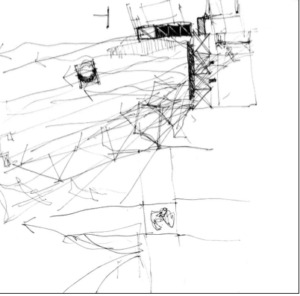
Creativity and the Development of New Ideas: The Generative Potential of Visual Literacy Brad Hokanson University of Minnesota, USA Abstract. The goal of this writing is to expand our understanding of visual literacy to include the capability to create and think using visual media. It begins with a reference to the way we ourselves work, think, and create. Following a brief examination of historical and contemporary descriptions of visual literacy, the current understanding of creativity is reviewed. How we create, whether internally through visualization or externally through distributed means is discussed. The use of external media to examine and develop ideas is mapped onto visual methods such as informal drawing, sketching, and thinking drawings. An examination of our own visual practices extend the scope of visual literacy to include thinking and creation. Keywords: Creativity, distributed cognition, visual media, visual thinking Read the full text.
Read More »
2018-2019 Dreams and Inspirations

Design: Changing Zeitgeists, Changing Communication

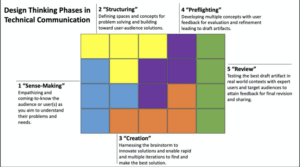
Design: Changing Zeitgeists, Changing Communication Philip B. Gallagher Iowa State University, USA Abstract. Teaching and learning how to communicate effectively is influenced by the zeitgeist of each new age. During each age, changing ideology, culture, and technology reshape communication and necessitate instructional redesign. An examination of communication instruction over the last half century reveals a trajectory toward designing documents using multiple modes of communication — the written, oral, visual, and electronic forms. This study looks at pedagogical change toward designing these artifacts in technical communication. It examines cultural attitudes affecting teaching practices and shows how communication instruction is trending toward visual, design-based methods for training technical writers. Ultimately, learning a design thinking practice is a worthwhile addition for teaching multimodal communication and document design for the digital era. Keywords: Design thinking, digital communication, multimodality, pedagogy, technical communication, visual literacy Read the full text.

Read More »
2018-2019 Dreams and Inspirations

Surveying Visual Literacy Guidelines for Information Design Application

Surveying Visual Literacy Guidelines for Information Design Application Randy Howe Fitchburg State University, USA Abstract. Visual literacy literature is full of guidelines established by various means — from personal taste to established traditions, perception studies, zeitgeist, and big data observations. This chapter explains how fifty guidelines and rules were taken from the literature and classified as a starting point for the creation of a more comprehensive and informed list. Guidelines and rules were randomly selected in this initial effort from some of the fields’ most respected theorists and practitioners among other sources. They were assembled to assist undergraduate students enrolled in a course titled Information Design to think critically about the design decisions made by professional information designers. This chapter further explains the methodology that went into the list’s creation, as well as specifics as to how it was applied in a classroom setting as an instructional aide, with additional reflection for possible enhancement. Keywords: Design rules and guidelines, information design, instructional method, visual literacy instruction, visual literacy luminaries Read the full text.

Read More »
2018-2019 Dreams and Inspirations

Constructing Arts-based Literacy Practices through Kwame Alexander’s The Playbook

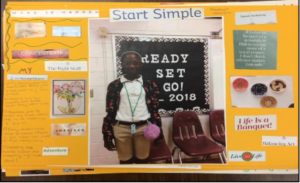
Constructing Arts-based Literacy Practices through Kwame Alexander’s The Playbook Anne Katz Georgia Southern University, USA Abstract. Teacher education candidates collaborated with local middle school students in order to cultivate reading comprehension, creative expression, and critical discussion skills through a visual literacy lens. Collaboration through a visual literacy lens is defined as a practice which invites students to construct meaning through images and text curated to express individual artistic expression. Undergraduate College of Education students enrolled in a Living-Learning Community “Investigating Contemporary Issues in Education” course exchanged pen-pal letters and created mini-lessons for middle school students around issues presented in Kwame Alexander’s The Playbook: 52 Rules to Aim, Shoot, and Score in This Game Called Life (2017) over the course of a semester. These students visited the school on several occasions to work with their pen-pals. Pairs conversed about life lessons and autobiographies of athletes presented in the book as well as how the text (varying font sizes and colors, layouts, and the use of photographs and illustrations) affects the reader. They completed interactive activities guided by post-it note prompts and worked collaboratively to answer the prompts. The college students also worked with the middle school students to construct book-inspired arts-based text and image collages to represent their personal life philosophies. The question that this service-based research project seeks to answer is: “Would the use of targeted reading, writing, discussion, and arts-based literacy projects with public middle school students improve pre-service educators’ commitment to their field and expand their learning?” Keywords: adolescent literacy, arts-based literacy practices, community collaboration, engagement, motivation, university-school partnership Read the full text.

Read More »
2018-2019 Dreams and Inspirations

Funny feeling – Introducing a Performance Art Approach towards Visual Literacy

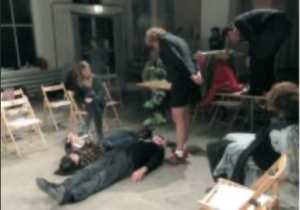
Funny feeling – Introducing a Performance Art Approach towards Visual Literacy Elke Mark Europe University Flensburg, Germany Abstract. How can one succeed in making the experience of a lecture performance comprehensible to people who were not present? How can it be translated into a text which still gives an idea of what happened? This paper is an experiential attempt to access the underlying complex tactile experience and the Gleichgewichtssinn (sense of balance) and translate it into a perceptible interactive experience. A textile ribbon approximately 60 meters in length, on which the whole lecture is printed as a single line, accompanied the experience. The ribbon was set up in the entrance of the lecture room serving as a guide to those who joined the audience. Based on visual imagination of the lecturer, and emphasizing a logic of its own, this concept introduces the example of a reading practice which acknowledges bodily experience, and opens visual literacy beyond usage and design. Keywords: Body, experience, performance art, reading, sensuous knowledge, tactility Read the full text.

Read More »
2018-2019 Dreams and Inspirations

Introducing Graphic Facilitation and Graphic Recording

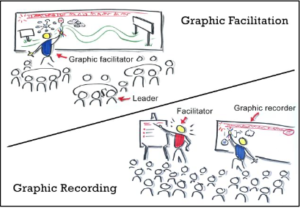
Introducing Graphic Facilitation and Graphic Recording Sharlene Kennedy Fusionary Thinking Abstract. This paper is intended as an introduction to the emergent field of graphic facilitation and graphic recording (GF/GR), which is a field at the cross-section of art, education and training, organization development, change management, and psychology. GF/GR holds particular relevance to those interested in expanding visual literacy in the workplace. The author includes a curated history, sample exercises and examples to illustrate the benefits of and similarities and differences between graphic facilitation and graphic recording. The foundations of GF/GR emerged in the 1960’s as a way to help organizations solve problems using large format group graphics and collaborative methods. Since its inception, various methodologies of graphic recording and graphic facilitation have been codified and taught. Inconsistencies in naming conventions, style and quality exist, however, between practitioners and trainers. Nevertheless, the field continues to grow in reach and relevance, particularly as technology provides increasingly accessible means to capture and share words and imagery. This paper is intended to help build understanding of the GF/GR field and appreciation for its potential impact on learning, growth and communication for individuals, groups and organizations. Keywords: Graphic facilitation, graphic recording, group graphic design, scribing, sketch noting, visual mapping Read the full text.

Read More »
2018-2019 Dreams and Inspirations

Paper, Pencil, and Crayons: A Case Study in Building Visual Literacy Skills for College

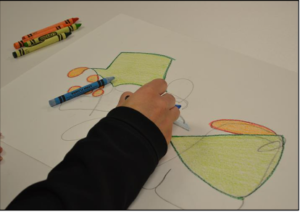
Paper, Pencil, and Crayons: A Case Study in Building Visual Literacy Skills for College Students Pamela Wicks and Meg Bero Aurora University, USA Abstract. A case study approach involved students enrolled in a sophomore-level visual communication course who struggle to construct a three-dimensional artifact using Photoshop. The students could not create a sense of depth needed for an effective composition. They did not understand how to translate their ideas to the landscape they were designing on a two-dimensional plane. Two case studies took place at a museum housed on the campus of a small liberal arts university in the Midwest. Students took part in a unit on composition in art, which was proposed to see how theory and practice worked when using the tools in the Photoshop program. This case study used the method of observation, analysis of documented student comments, student scores, and data collected from assessment reports to determine if learning occurred. Students met in the museum where they worked on creating visuals that started with the creation of three-dimensional displays, continued with blind contour drawing, and finished by creating art with construction paper. Overall, the unit served as a way to increase the learning experiences of the students in the Visual Communication class by providing them access to real pieces of art. They also learned the skills of observation and interpretation of art as a method needed to understand the construction of visuals. Keywords: Hands-on learning, museum artifacts, Photoshop, three-dimensional, visual literacy, Read the full text.

Read More »
2018-2019 Dreams and Inspirations

Visual Genealogy of Portraits, Self-Portraits, and Selfies: Same Phenomenon, Different Phase of History

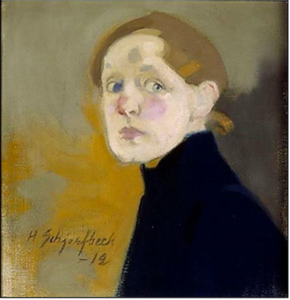
Visual Genealogy of Portraits, Self-Portraits, and Selfies: Same Phenomenon, Different Phase of History Margaretha Häggström University of Gothenburg, Sweden Abstract. This book chapter explores how the use of portraits has developed over the years. The purpose is to examine the genealogy of three types of portraits — portraits, self-portraits, and selfies — and to reveal similarities and diversity between these. A sample of portraits and self-portraits by painters, and selfies by amateur photographers, are analyzed through the four resources model by Freebody and Luke (1999). In this study, this model contains four theoretical concepts: visual code- breaking, visual meaning-making, visual use and visual analysis. The result shows that both professional artists, such as painters and photographers, and amateur photographers, are visual literate, but on different levels. Visual literacy ability is needed in all these types of portraits, and is always culturally grounded. The images included in this study, show the creators’ awareness of how to express specific personalities. Although, there are differences between the older paintings and today’s selfies, the similarities are more connected than might be thought. Keywords: Portrait, self-portrait, Selfie, visual literacy, identity creating, subject positioning Read the full text.

Read More »
2018-2019 Dreams and Inspirations

Discourses of Power in Historical News Photographs: Bain News Service and Representation in the Age of Imperialism

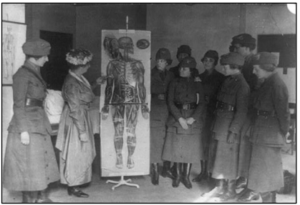
Discourses of Power in Historical News Photographs: Bain News Service and Representation in the Age of Imperialism Denitsa Yotova University of Maryland, College Park, USA Abstract. News photographs, as a form of visual communication, serve a critical role in the formation of knowledge and understanding of the past and present. The ability to interpret news images in the context of their production is an essential visual literacy skill that aids the effectiveness of both the production and the consumption of visual messages. To illuminate some approaches to the news image interpretation process, this paper investigates visual discourses of power in early twentieth century news photography. The study takes a closer look at one of the first news photo agencies in the United States, Bain News Service, and the images it provided to the American press. The visual representations of the social, political, technological, and cultural progress of the United States, as compared to other nations, demonstrate that the news photo service helped introduce, at least visually, both the domestic “self” and the foreign “other” to the American people in ways that suggested domestic superiority. The paper analyzes select photographs George Grantham Bain’s service produced between 1900 and 1920, to investigate how these mediated representations served to illuminate differences and otherness and to position the United States as a world power. Ultimately, the paper argues that Bain’s news photographs, as sold to and eventually published by the press, promoted a sense of nationalism and exceptionalism in the age of empire. Keywords: Bain News Service, news photography, visual image interpretation, visual literacy, representation, power, cultural diplomacy, nationalism, exceptionalism Read the full text.

Read More »
2018-2019 Dreams and Inspirations

Using Graphic Novels to Illustrate Empathy

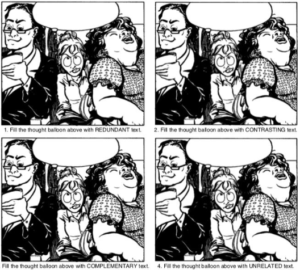
Using Graphic Novels to Illustrate Empathy Lee Okan Simmons University, USA Abstract. The graphic novel has long-served instructors as powerful teaching tools. Through graphic novels, students can pair visual images with words to examine how interdependent images and words can create a narrative. Graphic novels are essential for teaching students to think critically about personal experiences in the visual form, thereby teaching empathy. Graphic novels require visual learning to appreciate how the form addresses empathy. Graphic novels can be used to examine complex concepts. Artists can simultaneously depict stories internal and exterior conflicts of characters. This allows readers to become more empathetic to the characters. The visual form, as well as the accompanying narrative, provides an intimate medium to engross readers in parallel experiences. As educators struggle to engage students, the accessibility of graphic novels and their visually-rich narratives teach students both literacy and visual literacy. Through the images and the texts, students make connections and develop compassion for characters’ experiences. It is the connection of text and image interplay that conveys a greater sense of empathy with readers. This book chapter will analyze creators’ works in how readers learn compassion through the medium. Keywords: Graphic novels, visual literacy, empathy, immigration, intercultural teaching and learning Read the full text.

Read More »